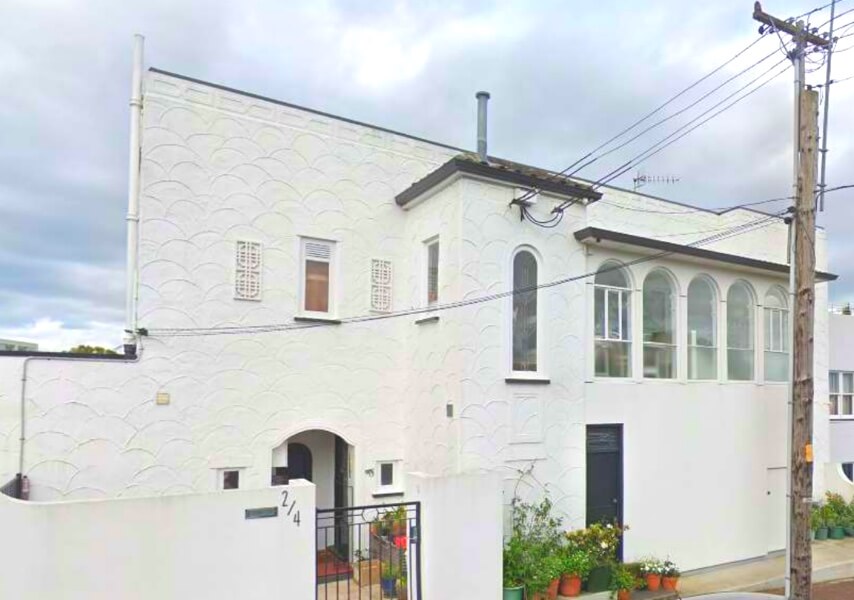
“Stroll along St. Heliers and no doubt the endless coastal road surrounding Waitemata Harbour and breathtaking views of Rangitoto Island will have you lingering. The same happened to the owner of 349 Tamaki Drive. He spotted this historic gem, where he envisioned to revitalise and elevate its value while embracing the historical soul of the building, bringing history past the facade into today’s trophy properties.”
The Rocket
A contemporary sculpture “Rocket” made by Favid McCracken, was installed just outside 349 Tamaki building bringing alive the idea that art can and should be enjoyed freely by the public.
David McCracken
Sculptor
Sculptor David McCracken mounted his first solo exhibition in 2000 and has been exhibiting throughout the Country since. His works, primarily from fabricated steel, have been included in many outdoor exhibitions including Headland Sculpture on the Gulf, Shpeshifter and Sculpture in the Gardens. In 2013, he was recipient of the Parsons and Brinckerhoff Award for Excellence in Engineering at Headland Sculpture on the Gulf and winner of the Wallace Arts Trust NZ Sculpture Award.
The History Behind
The 349 Heritage
The background of this residential building goes back to 1935, which a Californianborn architect, A.B. Crocombe built for H Jenkins Esq, using a mixture of influences from the Marseilles Tile roof, and textured stucco, typical of the English Bungalow style popular during the late 1920s and early 1930s in New Zealand. This style is a forerunner to the “State houses'' designs. Most notable of American influence here is demonstrated in the arched windows, airbricks and vents, known as the “Spanish Mission Style”, reflecting early Spanish colonial buildings prevalent in the states of Texas and California. Applied plaster details to the doors, “quoins and the tops of pilasters under the eaves, and moulded parapet details over the flat roof section show this influence and Auckland Boys Grammar School and Lopdell House Museum in Titirangi are also two of the best known examples of this style.
Spanish Mission Style
Architectural Style
The architectural style is a mix of influences, reflecting the background of the Architect, and the fashions of the time. The Marseilles Tile roof and textured stucco are typical of the “English Bungalow” style popular during the late 1920s and early 1930s in New Zealand. This style was the forerunner of the “State house style'' and strongly influenced residential earlier “State house” designs.
Brighton Gardens
Embracing All The Merits
The heritage plans to be demolished in 2013 provoked a series of resentful critiques from the local architecture heritage society. Eventually, the plans were changed to refurbish and adaptive-reuse the whole apartment block, instead of demolishing it. The urban sketcher, Murray Dewhurst put this heritage into his sketch. He explained that “There’s nothing like sketching to make you slow down long enough to see something properly. After sketching awhile, I noticed the building has some very funky details including these archways and vents…”
From the Eyes of an Urban Sketcher
Urban Sketchers
Murray Dewhurst was invited to join Urban Sketchers as New Zealand correspondent. He also contributes as an editor to Urban Sketchers, helping to bring interesting storytelling content through words and sketches to thousands of readers all over the world. His sketches have appeared in The Art of Urban Sketching by Gabi Camponario, Reportage and Documentary Drawing by Veronica Lawlor, Architecture and Cityscapes by Gabi Camponario …
 ENQUIRY